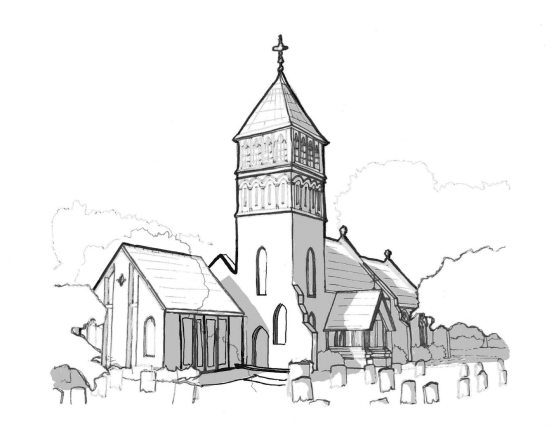
St James the Great is a mid-Victorian adaptation of an Early English church. The building today only dates back to the nineteenth century, although it has been a place of worship for nearly nine hundred years.
Geoffrey de Clinton granted Leek Wootton church to the priory he had founded at Kenilworth in 1122, and the chapel of Milverton was considered part of the grant. From 1232 Milverton church belonged to the Canons Regular of St Augustine of Kenilworth, a connection that lasted three centuries until Kenilworth Abbey's days ended in April 1539.
Existing records began in 1742, and the names of the men, women and children who lived in the parish from that date are found in the register of baptisms, marriages and burials. At least one of the time-worn stones in the churchyard is of an earlier date. Before the start of the nineteenth century, the Headmaster of Warwick School became the perpetual curate of Milverton.
By the nineteenth century the building had become a cause of anxiety: the upper part of the tower had given way, replaced by a wooden structure, and a clumsy buttress propped up the north wall. Six hundred years of wind and weather had left their mark on the masonry. Restoration was carried out from 1878, funded by Lady Charles Bertie of Guy's Cliffe. Nothing was left of the old fabric except the foundations and the lower tower.
Designs for the rebuild were drawn up by John Gibson, an eminent architect who in his younger days had been associated with Sir Charles Barry. Rebuilding was carried out by G. F. Smith of Rugby Road, New Milverton, and completed in the summer of 1880, with a service for the re-opening of the church on 28 August 1880. The new church featured the unusual pyramidical roof of the tower and the arcading around the upper storey; the walls are of sandstone from a local quarry, the quoins and tracings of Hollington stone.
A glazed screen inside the south porch celebrated the Millennium, dedicated in April 2001. Its engraved scallop shell, St James' emblem, recalls the shells worn by medieval pilgrims to his shrine at Compostela in Spain. The first vicar to occupy the new vicarage was the Rev. Montague Mercer Pope MA (Oxon), who held the living for about thirty-five years. Since then we have had over thirty vicars.